

Eating for Your Dosha: What Ayurveda Means by Agni

Two people can eat the exact same meal and walk into completely different afternoons.
By Jonathan Brooks
One works cleanly through to dinner. The other is heavy eyed by three o'clock, blaming the food. Ayurveda, the traditional medical system that developed on the Indian subcontinent, sorts that kind of difference by dosha, the constitutional pattern that shapes how your body tends to run, and it explains the whole gap with one idea: agni, the digestive fire that decides what a meal actually becomes once it is inside you, not just how it tasted going down.
This is really what eating for your dosha comes down to. Not a special diet, not a list of forbidden foods lifted off a chart online, but a pattern of timing and temperature that keeps your particular agni doing its job instead of falling behind.
The short version
Here's the short version if you only have a minute.
Agni, your digestive fire, decides how well a meal gets used, not just what's in it.
Warm, cooked food is generally easier on agni than cold or raw food, especially at night.
Your biggest meal works best around midday, when agni tends to run strongest.
Each constitutional type throws agni off in its own direction, and the fix is different for each.
Herbal formulas work better once agni is already functioning, not instead of it.
What agni actually is
Agni is not a metaphor Ayurveda uses loosely. It is the working idea that how well you digest matters nearly as much as what you actually eat, and it moves. Some days it runs hot and capable. Other days, after a bad night of sleep or a stressful stretch at work, it drops, and food that would normally digest cleanly just sits there instead.
Ayurveda has a name for what's left when digestion does not finish its job: ama, the heavy, sticky residue blamed for that foggy, slightly swollen feeling after a meal that did not sit right. Ama is not really about any single food. It is what happens when agni was too weak for what got put in front of it.
A body running on weak agni gets less from a good meal than a strong agni gets from an average one.
Warm and cooked beats cold and raw, most days
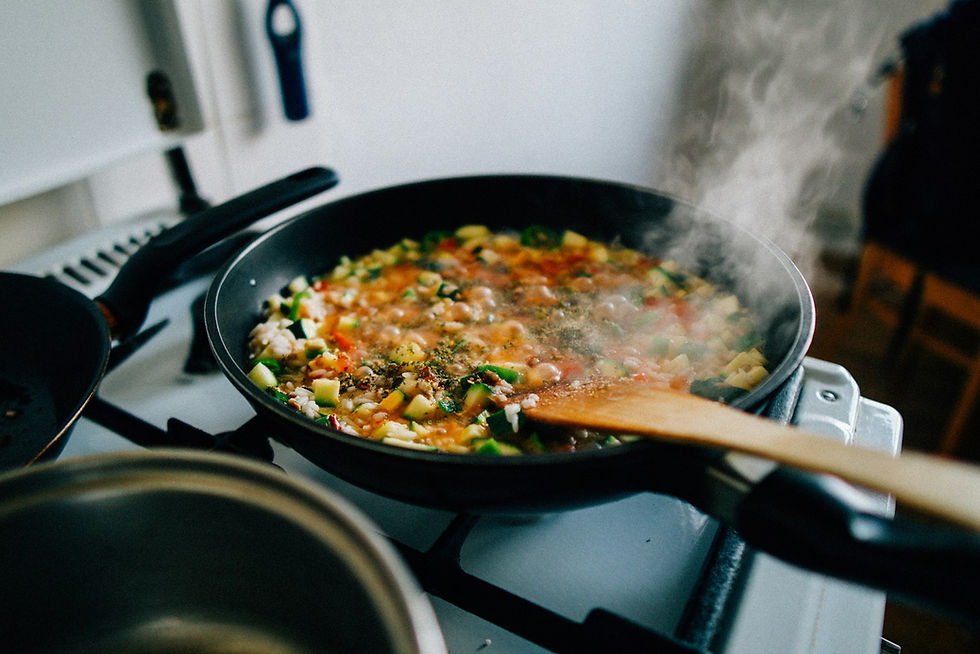
This is where Ayurveda's advice sounds almost embarrassingly simple: favor warm, cooked food over cold, raw food, especially at the edges of the day. A smoothie for breakfast and a giant cold salad for dinner are two of the most common ways people quietly ask their agni to do more with less.
Iced water at meals is the one habit I would change first. If someone asked me to fix just one thing about their digestion, it would not be a new supplement. It would be room temperature or warm water instead of ice, taken as anupana, the liquid used to carry a meal or an herb into the body.

Warming spices help for the same reason. Ginger, black pepper, cumin, and turmeric all show up again and again in traditional cooking, not as flavor accidents but as a working method for keeping agni lit.
A body already busy warming cold food back up has less capacity left over for actually breaking it down.
How to actually eat for your agni
1. Eat your biggest meal in the middle of the day
Agni is generally considered strongest when the sun is highest, which is a fairly unglamorous way of saying lunch, not dinner, should usually be the larger meal. A heavy dinner asks a naturally weaker evening fire to do the hardest job of the day.
2. Leave real space between meals
Grazing all day never lets agni finish one job before starting the next. Three to four hours between meals is a reasonable target for most people, longer if the last one was heavy.
3. Favor cooked over raw after dark
A big raw salad at eight in the evening asks tired agni to do its hardest digestive work at its weakest point in the day. The same vegetables, lightly cooked, ask much less of it.
4. Sit down and actually stop
Eating at a desk while answering email is its own kind of cold food, in a sense. Agni responds to a relaxed nervous system. A rushed, distracted meal digests differently than the same food eaten slowly, whether or not you notice it in the moment.
Where the doshas each go off balance at the table
This is really what your dosha actually tells you at the table: not a fixed diet, but which direction your particular fire tends to drift, and what nudges it back.
Vata, the quality behind quick movement and quick thought, that wired and exhausted feeling of running on empty while still somehow unable to sit still, tends to have the most unpredictable agni of the three. It can run hot one day and vanish the next, which is why regular mealtimes matter more for a vata constitution than almost anything else on this list.
Pitta, the sharp, driven quality that runs hot under stress, usually carries strong agni, sometimes too strong. Pitta types can often eat more than they should and get away with it for years, until spicy, fried, and acidic food catches up all at once.
Kapha, the heavy, steady quality that governs structure and stamina, tends to run the slowest and steadiest agni of the three, which sounds like an advantage until it tips into sluggish. That's the kind of heaviness nobody complains about until spring, when the same eating pattern that felt fine all winter suddenly feels like too much.
None of this is really about becoming a different eater. It is about noticing which of these three patterns sits closest to your own, most days, and adjusting timing and temperature accordingly.
Eating for your dosha is not a different diet. It is different timing and different temperature on mostly the same plate.
Where Ojaska fits
Herbs are not a substitute for any of this. They work with agni, not around it, which is the honest reason we built two of our formulas the way we did.
Triphala, the traditional blend of three fruits used across Ayurveda for gentle digestive support, is dosed at 250 mg, a 12:1 extract, one capsule twice daily, and it suits all three constitutions, which is part of why it shows up in so many routines regardless of dosha. Timing matters more for Triphala than almost anything else in the lineup, which is exactly the triphala timing mistake most people make: taking it whenever they remember, instead of matching it to their own digestion and the time of day.
Curcumin, our turmeric extract standardized to 95 percent curcuminoids at 485 mg, with 10 mg of ginger and 5 mg of black pepper extract, one capsule daily, fits especially well for Pitta and Kapha, the two constitutions this article spent the most time on. If agni is already weak, that is often why some curcumin supplements do nothing, no matter how concentrated the extract is. The herb was never the whole equation.
Honestly, of everything in this article, the agni piece is the one people resist the most. It is easier to buy a new bottle than to eat dinner an hour earlier or skip the ice in your water, and I understand why. I still reach for cold cereal some mornings when I am behind schedule, so I am not going to pretend this is easy to live by every day.
Read a supplement label the same way you would read a meal.
If a bottle asks you to take it on an empty stomach with ice water first thing in the morning, it was not written with your agni in mind.
These statements have not been evaluated by the Food and Drug Administration. This product is not intended to diagnose, treat, cure, or prevent any disease.
None of this replaces a conversation with a qualified practitioner if something feels seriously off. It just means paying attention to the fire, not only the fuel.


Comments