

Kitchari: the one pot meal Ayurveda keeps coming back to

The most quoted dish in the tradition has three ingredients and no technique, which is exactly why people keep looking for a more impressive version of it.
By Jonathan Brooks
Type kitchari into a search bar and the results split two ways. One half wants to sell you a cleanse, a program, a ten day reset with a shopping list of add ins. The other half wants to convince you it is boring, a bland rice thing you eat when you are sick. Both miss what the dish is actually doing. Kitchari is rice and split mung dal, Vigna radiata, the split, husked legume most often labeled moong dal, cooked soft together with a small, fixed set of spices, and Ayurveda, the traditional health system of the Indian subcontinent, keeps returning to it for the same reason a good cook keeps a short list of dishes on rotation. It works, it is easy on digestion, and it does not ask much of the person making it.
The short version
Kitchari means rice and split mung dal cooked soft together with a short list of spices, nothing more.
The tradition's most recognisable dish is also its plainest one, and that is the point, not a limitation.
Rice and split mung together form what Ayurveda regards as a complete, easily digested meal.
The spices in a kitchari are not seasoning added at the end. They are part of how the dish gets digested.
Consistency across a season matters more than any particular version of the recipe.
Kitchari belongs in an ordinary autumn week as a dinner, not only as a cleanse or a sick day meal.
Why the tradition's most famous dish is also its plainest
Ayurveda organizes food around agni, the digestive fire, more than around any single nutrient or ingredient. A dish gets judged by how much work it leaves for digestion to do, not by how many components it has. Kitchari passes that test almost by accident. Rice is soft and neutral. Split mung dal, unlike whole lentils, has already had its tough outer skin removed, which is most of why it cooks down quickly and sits lightly once it is in you.
Put the two in a pot with water and a handful of warming spices and you get a dish that asks very little of agni compared to almost anything else on a plate.
That is not a small thing in a tradition built around digestive strength as the foundation of health generally. A dish that is easy to make is not automatically a dish the tradition would endorse. Kitchari earns its place because it happens to be both simple and genuinely light to digest, and those two facts are not the same fact even though they usually get regarded as one. Cooked, soft food generally asks less of agni than raw food does, which is part of why the same logic favors cooked food over raw through an autumn week, not only inside this one dish.
Rice and split mung, and what the pairing does
Rice and lentils together is a pairing that shows up across a lot of food traditions, and Ayurveda has its own specific read on why this particular combination works. Split mung dal on its own is considered a fairly light, easily digested protein source, and rice on its own is a gentle, quickly digested carbohydrate. Cooked together into one soft, spoonable texture, the two stop behaving like separate ingredients on a plate and start behaving like a single dish, which is closer to how Ayurveda actually wants a meal to be handled by the body.
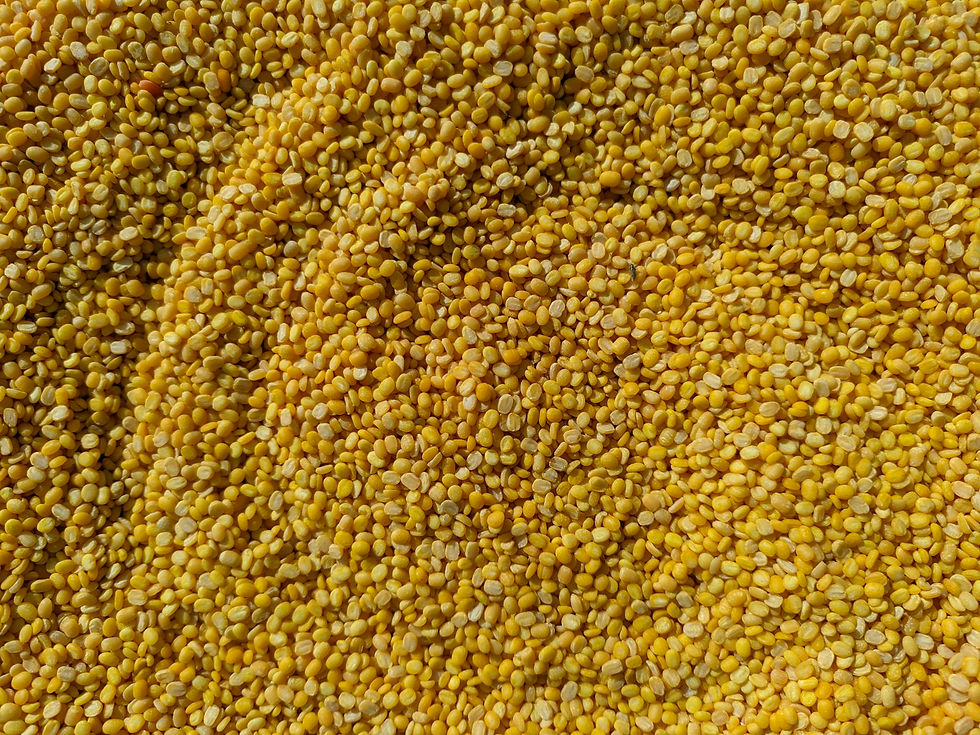
The ratio matters less than people assume, though most versions lean toward more rice than dal rather than an even split. What matters more is the texture. Kitchari is meant to be cooked until soft, closer to a thick porridge than to rice and dal served as two distinct sides. That softness is doing real work. It is most of the reason the dish reads as gentle on digestion in the first place, and a version cooked too dry and separate is not doing the same job even if the ingredient list is identical.
The spices are not optional
Cumin, coriander and turmeric show up in almost every version of this dish, and it is worth saying plainly that they are not there for flavor alone. Ayurveda's own logic reads a spice by what it does to agni, not simply by how it seasons a finished dish. Cumin and coriander are both read as digestive aids in their own right, gently warming and carminative. Turmeric adds its own warming, slightly bitter quality on top of the color it is best known for.

Skip the spices and you still have rice and lentils, but you no longer have kitchari in the sense the tradition means it. Honestly, I think the marketing that turned an everyday dinner into a ten day protocol is the part of this conversation actually worth criticizing, not the dish itself. That marketing regards the spices as decoration and the dish as a vehicle for restriction. The tradition regards the spices as half the point. A properly spiced pot of rice and dal is doing digestive work through the cumin and coriander and turmeric in it, not through the absence of other food around it.
Kitchari's spices are doing something more specific and more modest: making a plain meal easier to process, meal after meal, rather than promising a transformation in ten days.
Consistency matters more than the recipe
Every household that cooks kitchari regularly has its own version, and that is closer to the point than any single authoritative recipe would be. Some cooks add a vegetable, some do not. Some use more turmeric than others. What the tradition actually cares about is that the dish gets made the same simple way often enough to become familiar to a particular digestion, not that it gets made exactly one correct way.
This is where the marketing version of kitchari goes furthest wrong. A dish designed to be unremarkable and repeatable gets rebuilt as a special event, complete with a strict schedule and a list of foods to avoid around it. The tradition never asked for a special event.
It asked for a meal simple enough to make often, so that agni gets a break from more demanding food on a regular basis rather than only during a designated cleanse window.
Where it fits in an ordinary week
Kitchari earns a genuinely ordinary place in an autumn week rather than a role reserved for illness or for a formal reset. As the season turns and ritucharya, Ayurveda's seasonal routine, moves toward warmer and more grounding food, a soft, warm, spiced pot of rice and dal is close to an ideal weeknight dinner. It asks little of a kitchen and little of digestion, which is a useful combination on a night when neither one has much to give.
It also sits comfortably next to the rest of an autumn plate built around warm, moist food, rather than standing apart from it as a special case. A bowl of kitchari with a little ghee stirred in, alongside cooked vegetables, is a complete meal without needing anything unusual added to it.
A capsule of Ojaska Curcumin, standardised turmeric extract with ginger and black pepper extract taken one capsule daily after meals, sits easily alongside a dinner like this rather than replacing anything in it. The pairing is not a substitution. Turmeric in the pot and turmeric in a capsule are simply two different ways the same idea shows up in a day built around supporting agni rather than overloading it. The longer version of that thought, why most turmeric never gets very far on its own, is worth reading next to a pot with turmeric already in it.
The dish most often searched for as something impressive is, in practice, the plainest one the tradition has. That is not a contradiction worth resolving. It is most of the reason it has lasted this long.
These statements have not been evaluated by the Food and Drug Administration. This product is not intended to diagnose, treat, cure, or prevent any disease.


Comments