

What Ayurveda Changes on the Plate When the Air Turns Dry

Autumn produce is at its best raw and cold, crisp out of a crate at the farmers market, and that is exactly the form this particular season handles worst.
By Jonathan Brooks
Ayurveda, the traditional medical system of the Indian subcontinent, has a name for this exact stretch of the year: vata, the constitution built from air and space that shows up in the body as dryness, quickness and cold, whatever a person's usual constitution looks like the rest of the year. A vata season plate is not a special diet reserved for one kind of person. It is what the tradition asks of anyone eating through a dry, windy month, and it happens to run directly against the instinct that autumn's crisp new produce is best served raw.
The short version
An autumn plate, by this logic, wants three qualities working together rather than any single ingredient.
Warm food beats cold food for most of the day, not only at dinner.
Moist, oily preparation matters more than any single vegetable choice.
Mildly sweet, sour and salty tastes settle a dry season better than bitter or astringent ones do.
Raw salads are not wrong, they are simply timed for the wrong season.
Fat in the pan is not decoration. It is how a dry season gets carried into the body.
A small closing habit after the meal matters as much as what went on the plate.
The three qualities an autumn plate wants
Ayurveda reads every dish through a short list of qualities rather than a calorie count or a food group, and three of them do most of the work in a dry season. Warm beats cold. A meal that arrives hot, or at least well above room temperature, is doing some of digestion's job before the first bite ever lands. Moist and a little oily beats dry. The season is already pulling water out of the air and, the tradition would say, out of the body along with it, so a meal that adds a bit of that moisture back is working with the season instead of against it. Mildly sweet beats sharply bitter. None of this means heavy or rich. It means the opposite of crisp, cold and dry, which happens to be exactly the direction most produce naturally points in October.
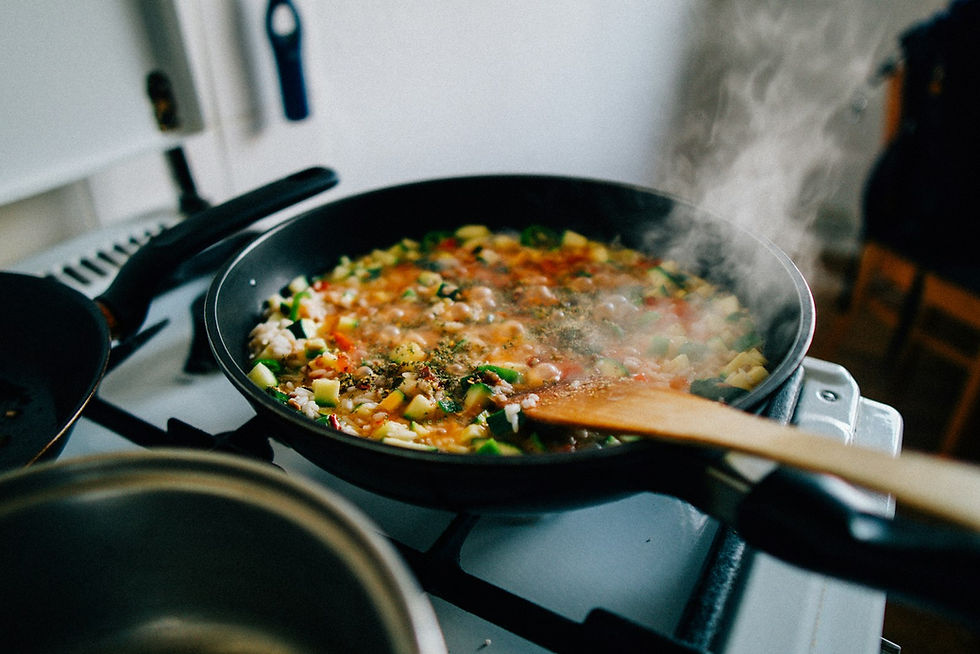
None of the three qualities is exotic. A bowl of something stewed, holding its own broth, arrives already warm and moist without anyone doing anything unusual to it.
The three qualities are less a recipe than a filter you run a normal week of meals through.
The salad problem, and what to do instead
Here is the actual friction point. Late season produce, the last tomatoes, the first hard squash, a case of apples, is genuinely at its best right now, and the instinct to eat it raw and unadorned is a reasonable one most of the year. In a dry, windy month it works against the plate this tradition describes. A raw salad is cold, dry and full of the light, quick qualities vata already has too much of, and eating a big one as the main event of a meal is asking a stretched thin digestion to process the hardest possible version of the job.
The fix is not giving up the vegetable. It is changing what happens to it before it reaches the plate. A hard squash roasted until it collapses, a bundle of greens wilted in a pan rather than served raw, root vegetables simmered until a fork slides through them without resistance: these are the same ingredients a raw plate would use, cooked into the warm, moist form the season actually asks for. Nothing here is a downgrade. It is the same produce, meeting the moment it is actually in.

Fat is a carrier, not a garnish
A drizzle of oil at the end of cooking is doing almost nothing. Fat added early, while a dish is still building heat, has time to carry flavor and warmth all the way through the vegetable rather than sitting on top of it. This matters more in a dry season than in a wet one, because fat is one of the few things reliably read as both warming and moistening at once, which is exactly the pairing an autumn plate is short on otherwise.
Ghee, clarified butter used widely in Ayurvedic cooking, is the classical choice here, though a good olive or sesame oil works on the same logic. The amount does not need to be large. What matters is when it goes in and how completely it gets absorbed into what it touches, not how visible it looks once the dish is plated.
That fat is also doing information work for agni, the digestive fire that Ayurveda frames as the engine behind whether a meal gets absorbed easily or simply passes through. A well fed digestive fire handles a heavier, oilier meal without complaint. A weak one struggles with a dry, under oiled one just as much as a rich one, which is part of why the agni conversation and the autumn conversation keep circling back to the same point: what a meal is doing for digestion matters more than what any single ingredient supposedly does on its own.
The tastes that steady a dry season
Ayurveda groups food by taste as much as by ingredient, and three tastes in particular counter the dryness and quickness of the season. This is not a list to follow at every meal. It is a direction to lean toward across a week.
1. Sweet
Not sugar. A baked squash, a ripe pear, a bowl of warm oats: these register as mildly sweet in this framework, and sweet is read as the most grounding, moistening taste available. It is the taste this season wants more of, in its plain whole food form rather than its refined one.
2. Sour
A squeeze of lemon over a roasted vegetable, a spoon of yogurt alongside a stew: sour taste stimulates digestion and adds a small amount of moisture on its own. In small amounts, alongside a meal rather than as the meal, it earns its place on an autumn plate.
3. Salty
A pinch more salt than usual, used with care rather than abandon, adds warmth and helps a dry, light season feel less like it is scattering in every direction.
The three tastes working together do more than any one of them alone.

Closing the meal, and what happens after
Honestly, I think the raw food default, the quiet assumption that a cooked vegetable has lost something a raw one still has, gets this particular season exactly backwards. Cooking is not a loss here. It is the step that turns produce built for a different season into something this one can actually use. A stewed carrot has not been damaged on its way to the plate. It has been changed into the form a dry, windy month asks for.
What happens after the last bite matters almost as much as what came before it. Ayurveda has long paired a meal with something afterward meant to support the same digestive fire the meal itself just asked something of, rather than regarding the end of eating as the end of the conversation. Triphala, the three fruit formula built around exactly this closing moment, combines amalaki, an Indian gooseberry, bibhitaki, a related dried fruit, and haritaki, a third fruit traditionally paired with the other two, and Ayurveda classifies the combination as a support for agni that suits any constitution rather than one built for a single season alone. Ojaska's Triphala is made from a 12 to 1 extract of the three fruits at 250 mg, taken as one capsule twice daily after meals, which places it at the same point in the day this whole piece keeps returning to: right after the plate, when digestion is doing its actual work.
None of this asks for a kitchen overhaul. A stew instead of a salad most nights, a little more fat added earlier in the pan, a taste check across the week rather than at any single meal, and a small closing habit once the plate is empty. Together those are most of what an ayurvedic autumn diet actually is.
Where this fits into a bigger picture
Food is one piece of a season Ayurveda maps in much more detail. Ritucharya, the six season Ayurvedic calendar, places this exact stretch of the year in a wider rhythm that governs routine and rest as much as meals. Fat's role on the plate has its own deeper logic worth reading in full: ghee's classical use as a carrier rather than a condiment applies directly to the cooking described above. Readers curious whether the dryness described here matches their own constitution, in every season rather than only this one, can start with what vata actually is.
The tradition's logic of taste and timing does not stop at solid food either. The same questions of heat, dryness and when something reaches the body apply just as directly to coffee, which turns out to be a useful comparison for anyone trying to work out why the same habit feels different depending on the hour.
These statements have not been evaluated by the Food and Drug Administration. This product is not intended to diagnose, treat, cure, or prevent any disease.


Comments