

Bitter greens: why Ayurveda still wants that taste in a sweet season

Ask someone to name the taste missing from their meals this week and almost nobody says bitter, which is usually exactly the one that is missing.
By Jonathan Brooks
Sweet gets named. So does salty, sometimes spicy. Bitter almost never comes up, not because people dislike it exactly, but because it rarely gets served long enough to notice its absence. October makes this worse. The season leans into warm, sweet, well oiled food, for good reason, and bitter greens are the first thing a heavier plate quietly drops to make room.
The short version
Bitter is tikta rasa, one of six tastes Ayurveda, the classical Indian medical tradition, tracks on every plate, and it is usually the first one a rich season drops.
The tradition classifies tikta rasa as light, cooling and drying, useful in small amounts and easy to overdo in a season that is already dry.
Cooking bitter greens changes their texture and their heat but not the underlying classification the tradition assigns them.
A small serving early in a meal is the traditional placement, not a full plate on its own.
Ojaska's Moringa, a 500 mg twice daily leaf extract, is one way to keep a pungent, light taste in the day without building a whole dish around it.
The honest issue is a modern palate that has quietly bred bitterness out of the produce aisle, not the taste itself.
The taste that quietly leaves the plate in October
Six tastes show up in the classical texts: sweet, sour, salty, pungent, bitter and astringent. A full meal is supposed to touch most of them, and for most of the year that happens without anyone planning it, since a normal plate of vegetables, grains and a squeeze of something sour covers a lot of ground on its own.
Autumn changes the math. The season's own eating pattern leans sweet and heavy on purpose, built around root vegetables, warm grains and more oil than summer ever asked for, and that shift is a reasonable response to drier, cooler weather. But sweet, heavy food crowds a plate in a specific way. Bitter greens, the vegetable most likely to carry that taste on an everyday table, get pushed to the edges first, then off the plate entirely once a menu is planning around comfort rather than variety.
Nobody decides to drop bitter on purpose. It just loses out, meal after meal, to a season that rewards a different set of tastes, until three weeks in, the taste has quietly disappeared and nobody actually chose that.
What bitter is classified as doing
The classical texts record tikta rasa (bitter taste, one of six the tradition tracks) as light and drying in its guna, the inherent qualities Ayurveda assigns to a substance, and cooling in its virya, the heating or cooling potency a food is expected to carry once digestion is underway. Those three words, light, drying and cooling, do most of the predictive work the tradition asks of any taste.
A light, cooling, drying taste is traditionally read as the opposite of the qualities that build up during a season leaning toward Kapha (the constitutional tendency toward heaviness and steady structure), which the cooler months are already nudging most bodies toward. That is the traditional logic behind keeping bitter in the rotation deliberately rather than letting it disappear: it is doing work a sweet, oily season does not do on its own. The fuller four part system behind rasa, virya and the other properties the texts track for any single herb is covered in more depth in how Ayurveda actually classifies an herb, which goes past taste alone into what a substance does once digestion finishes with it.
None of this makes bitter a substitute for the rest of the plate. A light, drying, cooling taste eaten in excess is exactly as capable of causing its own kind of imbalance as too much sweet is, which is part of why the tradition never asked for a plate built entirely around it.

Cooked bitter greens, and the dryness problem
Raw bitter greens are the more familiar version in most modern kitchens, tossed into a salad where the sharpness stays intact. Cooking changes that experience considerably. Heat softens the leaf, rounds off some of the sharper edge, and makes a bitter green considerably easier to eat in a real portion rather than a token handful.
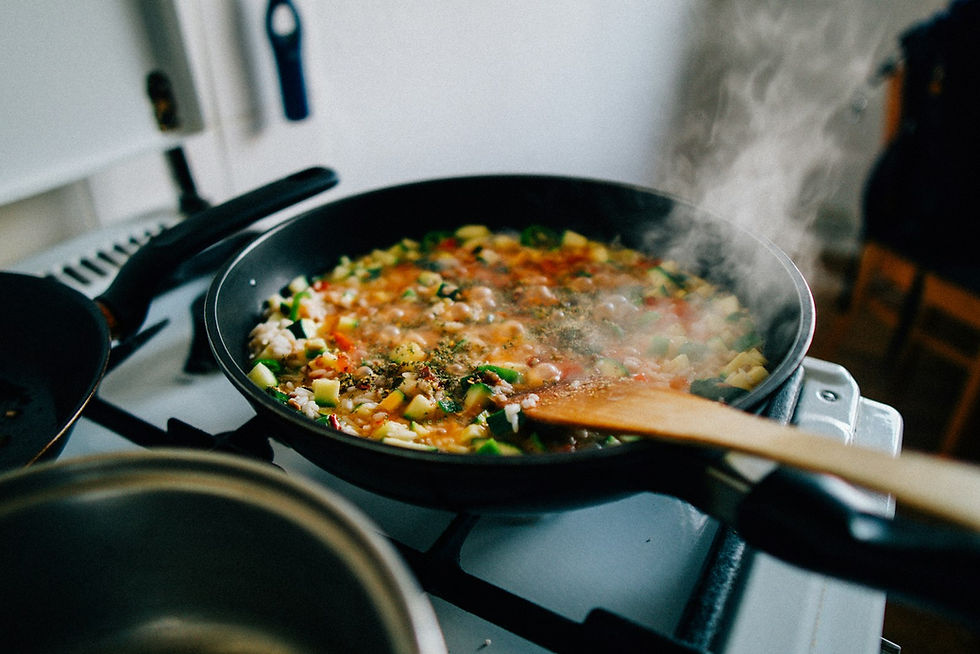
What cooking does not change is the underlying classification the tradition assigns the taste itself. A wilted, cooked bitter green is still read as light and drying, even once it has picked up oil and heat in the pan, because that reading describes the taste category rather than the specific dish.
This is exactly why the tradition never regarded cooking as a way to cancel out a food's basic qualities, only as a way to make them easier to work with.
That drying quality is the detail worth watching in October specifically, since the season is already nudging the body toward dryness on its own, the same dryness an autumn plate built around warm, moist food is designed to counter directly. A bitter green cooked with a generous hand of oil, rather than dry sauteed or boiled and left plain, is the traditional answer to that overlap. The oil is not decoration. It is the part of the dish actively working against the dryness the vegetable itself brings to the plate.
Small amounts, early in the meal
The traditional placement for bitter greens was never a whole plate on its own, and that detail gets lost in a lot of modern framing that regards bitter as a virtuous food to eat in maximum quantity. A modest serving, early in a meal rather than as the entire meal, is closer to how the texts actually describe it, precisely because tikta rasa's light, drying qualities are meant to sit alongside heavier, more grounding food rather than replace it outright.
This is the same logic that shows up in how agni, the digestive fire, gets weighed against everything eaten in a day. A digestive fire working through a heavy, oily October meal benefits from a light, bitter opening course the same way a meal benefits from a gap between courses rather than a single dense plate arriving all at once.
Bitter greens sauteed with garlic and a little ghee, served as a starter or a side rather than the entire dinner, is a reasonable modern version of that same old placement.

A bowl of kitchari, the plain rice and lentil dish the tradition keeps returning to, is one of the easiest places to fold a small handful of bitter greens in without building an entirely new dish around them. Stirred in during the last few minutes of cooking, they wilt down small, pick up whatever spice is already in the pot, and never have to carry the whole meal by themselves.
A leaf that carries bitter in a capsule
Not every day allows for a fresh bunch of bitter greens, wilted in a pan with garlic and ghee. Honestly, this is the part of the modern produce aisle that actually bothers me: bitterness has been bred and marketed out of vegetable after vegetable, until a shopper has to go looking specifically for the sharp tasting version of something that used to just taste that way. That is a complaint about what got engineered onto a shelf, not about the plant itself or about anyone's actual dinner plans.
A leaf extract is one honest way to keep a pungent, light taste in the day on a night the stove never gets used. Ojaska's Moringa, a 500 mg, 20 to 1 Moringa oleifera leaf extract taken as one capsule twice daily after meals, sits in the same general territory as tikta rasa, pungent and light rather than sweet and grounding, and it lives in the Gut and Metabolic collection precisely because that lighter, moving profile is the point rather than an afterthought. Shigru, the classical name moringa carries in the older texts, was never filed under bitter exactly, its recorded rasa leans pungent, but the two tastes share enough of the same light, moving qualities that a capsule built around one fits naturally into a conversation about the other.
A capsule is not a replacement for an actual bunch of greens in a pan.
It is a way to keep one property, lightness, moving through a day that a heavier October menu is otherwise built to avoid.
Bitter greens never asked for much: a few minutes of heat, a spoon of oil, a place near the start of the meal rather than the whole plate. The taste that gets skipped first this time of year is, by the tradition's own reasoning, one of the more useful ones to keep around, which makes it worth a deliberate spot on the weekly list rather than something left to reappear on its own.
These statements have not been evaluated by the Food and Drug Administration. This product is not intended to diagnose, treat, cure, or prevent any disease.


Comments